
 English
 Español
 Pусский
 Français


Bauer fiber classifier
Certainly — here is a 500-word English description without mentioning any company name:---A fiber classifier is a specialized industrial machine designed to identify, separate, and grade different types of fibers according to their physical and structural characteristics. It plays an important role in textile processing, recycling, material sorting, and quality control. By analyzing properties such as fiber length, thickness, color, density, and composition, the machine helps ensure that materials are accurately categorized for the next stage of production or reuse.In modern manufacturing environments, fiber classification is essential for improving efficiency and maintaining product consistency. A fiber classifier automates a task that would otherwise require extensive manual inspection, reducing labor costs and minimizing human error. It can process large volumes of mixed material quickly and with a high degree of precision. This makes it especially valuable in facilities that handle raw textile fibers, synthetic blends, natural fibers, or post-consumer textile waste.The machine typically uses advanced sensing and sorting technologies to distinguish between fiber types. Depending on the model, it may combine optical recognition, air separation, mechanical screening, and electronic detection systems. These technologies allow it to analyze incoming material in real time and direct each fiber category into the appropriate output channel. Some systems are capable of distinguishing cotton, wool, polyester, nylon, viscose, and blended materials, making them highly versatile in industrial applications.A key advantage of a fiber classifier is its ability to improve material purity. In textile recycling, for example, fibers from discarded garments or production scraps often arrive in mixed and contaminated form. Accurate classification helps recover usable fibers and separate non-fiber impurities, supporting more sustainable production methods. In addition, better sorting results in higher-quality recycled materials, which can then be used in spinning, nonwoven manufacturing, insulation production, and other downstream applications.Another important benefit is process optimization. When fibers are classified correctly at the beginning of production, later stages become more stable and efficient. Equipment experiences fewer interruptions, waste is reduced, and the final product is more uniform. For manufacturers, this can lead to lower operating costs and better resource utilization. For recycling operations, it increases recovery rates and supports circular economy goals by extending the life cycle of materials.A fiber classifier is also designed with durability and reliability in mind. Because it often operates continuously in demanding industrial settings, the machine must withstand dust, vibration, and high throughput. Many systems feature user-friendly control interfaces, adjustable sorting parameters, and easy maintenance access. These features allow operators to adapt the machine to different fiber types and production requirements.Overall, a fiber classifier is an essential tool for modern fiber processing. It combines speed, accuracy, and automation to improve sorting efficiency, material quality, and sustainability. Whether used in textile production or recycling, it helps transform mixed raw materials into organized, usable resources. As industries continue to emphasize efficiency and environmental responsibility, fiber classification technology will remain increasingly important.---If you want, I can also make it sound more technical, sales-oriented, or SEO-friendly.
نتاج
تصنيف:
-
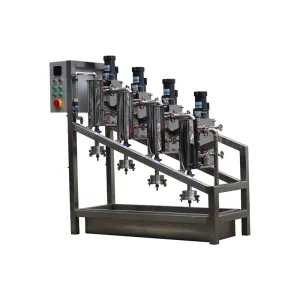
Bauer Fiber Classifier
تصنيفها: Pulp Testing Instrumentsالمشاهدات: 157عدد:وقت الإصدار: 2026-08-14 08:48:21The Bauer Fiber Classifier is a specialized instrument for determining the weight-average fiber length of pulp fibers using the screening method in pulp and paper laboratories. It measures the proportion of fibers of different lengths in pulp and reveals the distribution of various fiber lengths in the stock. The instrument complies with GB/T 2678.1-1993, TAPPI T233 cm-95, and the Nordic SCAN M6 (10g sample, 15min water flow, 10L/min flow rate) screening methods. It features 4 screening stages, a screen chamber capacity of 10 liters, a stirrer speed of 580±1 r/min, an adjustable water flow rate of 0-20 L/min (display accuracy 0.5%R), and an adjustable screening time of 0-9999 minutes. The main body is made of 304 stainless steel with a power supply of 240W/380V and a net weight of 130 kg. The factory default screen set is for medium-long fibers (14, 28, 48, 100 mesh), with long and short fiber screen combinations also available. This instrument is an essential device for fiber morphology analysis and pulp evaluation in paper mills, research institutes, and quality inspection agencies.
أخبار
تصنيف:
لا توجد نتائج بحث!
حالة
تصنيف:
لا توجد نتائج بحث!
فيديو
تصنيف:
لا توجد نتائج بحث!
تحميل
تصنيف:
لا توجد نتائج بحث!
تجنيد
تصنيف:
لا توجد نتائج بحث!
المنتجات الموصى بها
لا توجد نتائج بحث!



 هاتف
هاتف